note: there are two books linked below, both of which are free to digitally borrow and read with an Archive.org account
Alfred Hitchcock’s 1940 spy thriller Foreign Correspondent is not the most well-known film of the legendary director’s long career, but it is generally praised both as an influential early spy genre piece and as a historically relevant window into the atmosphere of pre-war Europe. The source material for Foreign Correspondent was a 1935 memoir by American journalist Vincent Sheean entitled Personal History which describes the author’s time working as a foreign correspondent in the 1920s and 30s. While the dozen-or-so screenwriters who created what would be the eventual screenplay for the film did not ultimately keep all that much from the source material, Sheean’s editors certainly would have appreciated the image boost that comes from an Alfred Hitchcock stamp of approval.
Vincent Sheean himself, however, would not have been in much of a position to enjoy the fruits of his labor. By the time Foreign Correspondent released in the United States, Sheean was watching battles off the coast of Dover and dodging air raids in what would become known as the Battle of Britain. While the wartime censorship boards severely restricted his ability to publish accounts of these battles in real time, Sheean maintained a record of events and would later compile them into Between the Thunder and the Sun, which was first published by Random House in 1943.
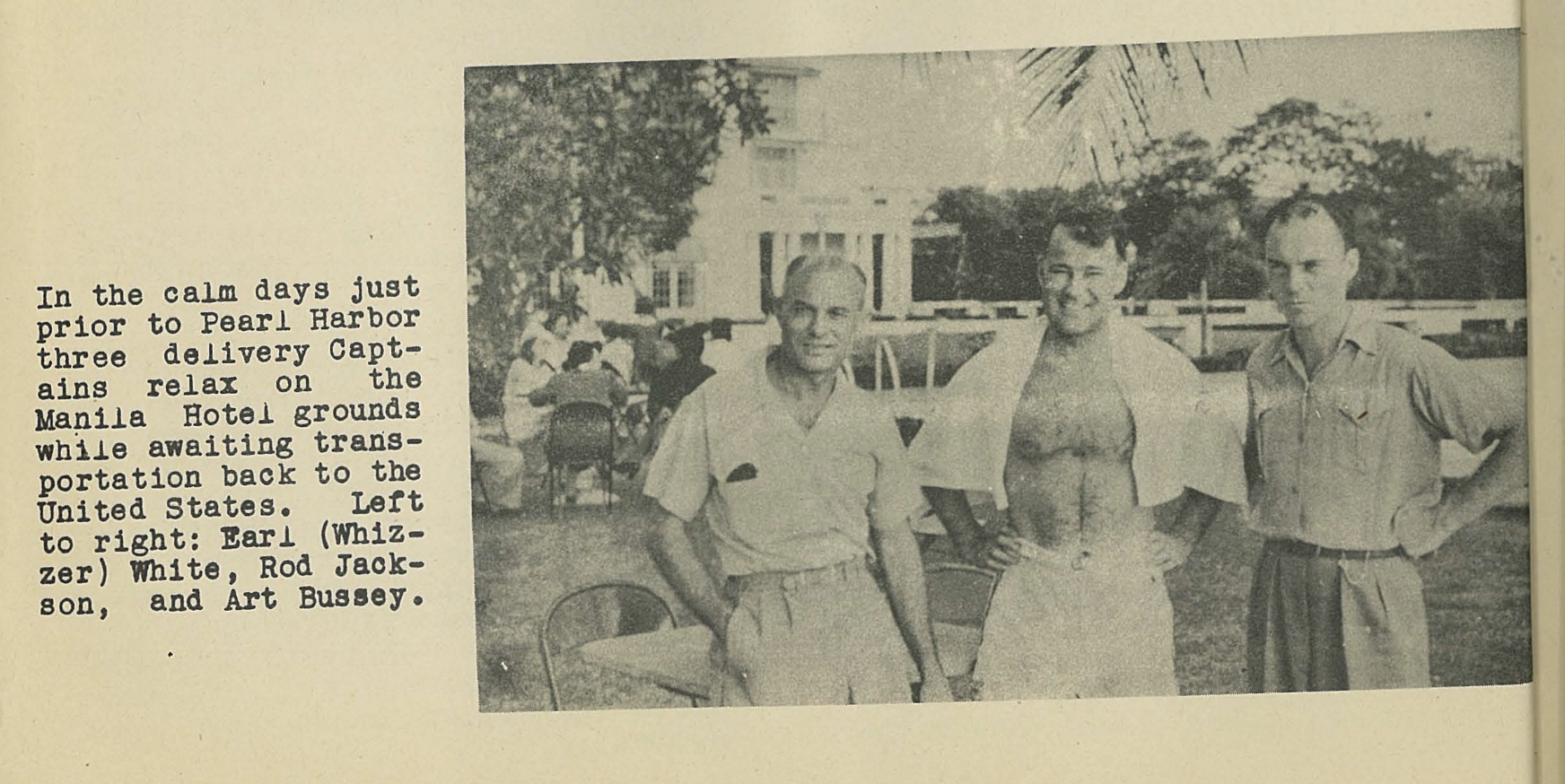
This third and final memoir of Sheean’s career covers the transition period going into the war, starting with the 1939 Salzburg Music Festival and ending with Sheean’s enlistment into the Air Corps in May of 1942. In Chapter 8, Sheean recounts a journey he took from Manila to San Francisco on the Pan-American “American Clipper” right before Pearl Harbor was attacked. Also aboard the plane were “the crews of the Consolidated flying boats (PBY’s), who were being ferried back to San Diego.” Rodney H. Jackson was among this group of pilots, who had been ferrying new aircraft from Consolidated’s factory in San Diego to various locations in the Pacific for several months.
1940 aerial view1 of a PBY-5 “flying boat” over San Diego’s Consolidated aircraft factory
Manila and Guam
The first mention of the pilots comes early in the chapter,2 while Sheean is describing the attitudes of his fellow passengers on the first leg of the journey from Manila to Guam.
The ferry pilots—there were parts of four bomber crews aboard—chiefly slept. They had been too gay and noisy the night before to feel talkative today. We had had a false start from Manila. The Clipper had absorbed all its passengers and luggage at the Cavite seaplane base and started its run at about half past three in the morning. It made a longish run, tugging to get off, and then the second starboard engine emitted a decisive noise and ceased to function.
“Plug,” the ferry pilots said to each other; this was on the night of the false start, when they were feeling gay and talkative.
It was all repeated the next morning, except that this time the excitement of departure was lacking. The Clipper took off with something like a maximum load, waddled into the air like an elephant and set its course for Guam. After the dense and humid heat of Manila it was pleasant to climb into the upper air and feel more or less cool again.
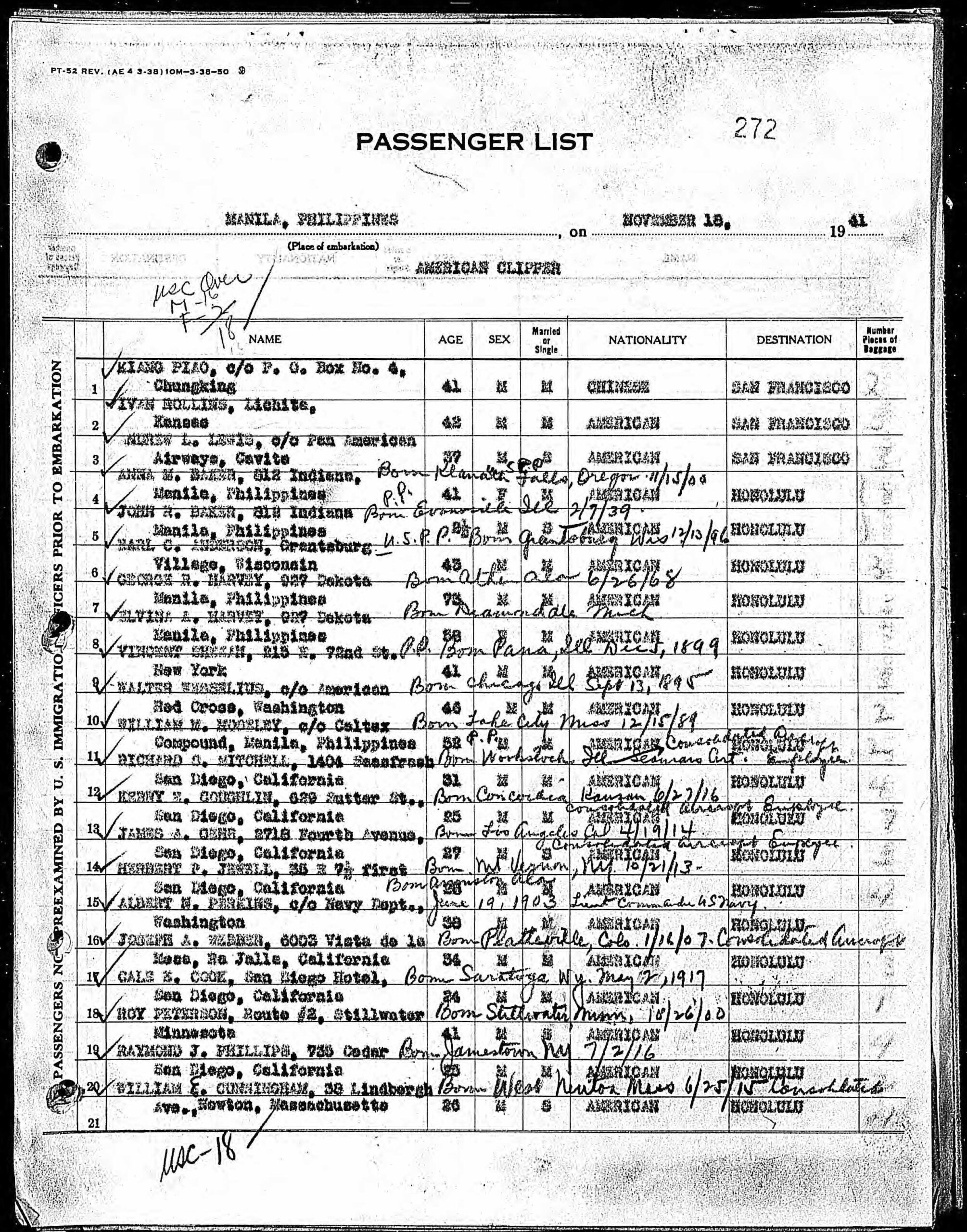
American Clipper passenger manifest from Manila. Note Vincent Sheean’s name on line 9 and Richard “Mitch” Mitchell on line 12.
After talking further about the heat of Manila, Sheean goes on to describe the atmosphere of impending war that would have greeted the ferry pilots in Manila.
I remembered the delegation of schoolboys who came to ask me what they ought to do in air raids. I had told them to go to their local office of civilian defense and they said there was none. [Manuel L.] Quezon in emphatic, clipped accent, his violet silk necktie and his fresh violet boutonnière quivering in sympathy, leaned across the luncheon table. “Either we shall have war immediately, very soon, or it will never come at all.” The great sleepy city, with no anti-aircraft guns and no air-raid shelters, spoke of war day and night, and in the shop as in the palace, in the club and on the street. An army wife, a very amusing woman, had said at a cocktail party only two nights before: “Evacuate? Catch me doing it. It’s sheer heaven here for an ageing female. Two or three hundred men to every woman. I’m staying.”
Some were not convinced that war was inevitable.
Douglas MacArthur, striding up and down in his shaded office within the walls of the old city, emphasized his every statement with gesture and ornate imagery: he harkened and heard, coming nearer every hour, the trumpets of immortality. Mr. [Francis B.] Sayre, the High Commissioner, in gentle, thoughtful words, depreciated it all: it was all so unnecessary and at the same time improbable. He did not really believe it. “You journalists,” he had the air of saying, without ever putting it so rudely into words, “are always alarmists.”
The “American Clipper” (NC 18606) two weeks after the journey described here3
The account of the Clipper journey continues:
We had our usual Clipper meals at the usual frequent intervals. Time is so fluid on these journeys that I have long since given up the attempt to change my watch more than once a day. You eat when you are fed, and let the stewards decide whether to call it breakfast, lunch, or dinner. The passengers never failed to do justice to the meals no matter how often they occurred. The ferry pilots displayed a rare talent for finding places to sleep. When I went back into the tail of the ship to get some cigarettes out of my overcoat I found three or four of them there, rolled up in blankets on the naked metal floor.
It was in the middle of the afternoon, as it seemed to us, when the stewards went the rounds of the windows, blacking them out. This blackout consisted of pulling down the curtains and fixing them at the bottom. They remained loose at the sides, and many passengers shamelessly gawked through the crack thus provided. We swooped down through the clouds and alighted on the smooth blue water of the seaplane base at Guam; the amateur blackout was lifted, and we looked out upon the scurrying launch of the Pan-American company.
The passengers were taken ashore by boat and released into a customs and immigration shed. It was warm on shore, but not as hot as Manila. Officers in khaki sat behind two desks in the shed, checking our names off a list, marking our nationalities. Except for a mysterious Swiss, a Chinese general and a Siamese jeweler (at least he said he was a jeweler), we were, I believe, all Americans.
After clearing customs, Sheean is invited to a dinner at Governor George McMillin’s mansion that evening by the Governor’s Aide-de-camp (A.D.C.), Captain Charles S. Todd. The passengers go their separate ways to wash up and those attending the dinner meet up later to drive to the mansion. Sheean continues:
The lounge of Pan-American Hotel on Guam in an undated photo4
When we emerged into the lounge of the Pan-American Hotel5 most of the bomber crews had already washed and changed. Many of them wore violent Hawaiian shirts, green and orange and blue and red, with shorts or slacks of almost any color. All this riot of habiliment gave the hotel lounge a look of the musical comedy stage. Captain Todd saluted some of them and we went out to get into his car. As we drove across the island in the brief and opulent sunset he told me about Guam, his Governor and his job. It was a paradisiacal island, with an equable climate, agreeable inhabitants and no income tax. The Chamorros, natives of the island, were the best-looking and probably the cleverest of the Pacific island peoples, a mixture of Polynesian and Filipino and Spanish, with some touch of American navy added in the past few generations. The inhabitants had no political rights or functions, all power being lodged in the Governor. Captain Todd, as A.D.C. to the Governor, was also chief of police for the island and head of the insular intelligence.
“It’s a wonderful job, really,” he said, his whole face crinkling with laughter. “I get reports on what everybody’s doing, all over the island. And then maybe I’ll see them the next day at the club and I have to pretend I don’t know what they’ve been up to. It’s pretty funny, sometimes. Now that the women have all been moved back to the States it isn’t so funny any more, but it used to be. And then I try cases, too, in the police court.”
He told me the story of the Spanish Governor, who, when the American warships approached and fired a broadside, in 1898, sent out his A.D.C. in a launch with a white flag and the message: “The Governor presents his compliments and regrets that he is unable to return the American commander’s salute, owing to the lack of gunpowder.”
The road led through woods and over hills, through two or three villages and past the marine officers’ quarters, where we stopped for a few minutes to talk to the commander. The villages looked Spanish or Filipino. In Agaña, the capital of the island, the single street was lined with bares entitled “Dirty Dick’s” and other humorous names. It seemed that there were about forty thousand Chamorros living on the island, a population very large for this limited area. Captain Todd, leaving the district of bars behind, turned smartly into the Plaza and drew up before the Palace.
It was a Plaza like that of any small provincial town in a Spanish country. One whole side was occupied by the jail; facing this was the Palace; on the third side was the Cathedral and the palace of the bishop; on the fourth side was the barracks and the museum. In the swift tropical dusk the white buildings looked remote and shadowy; we might have been in Andalusia. Captain Todd left the car at the Palace gate; a marine saluted; we went up the broad staircase of Filipino hardwood to a colonnaded terrace above the patio. This terrace apparently connected the two parts of the Palace, and was open to such breeze as stirred on the outer side. The Governor, Captain McMillin, was seated on the terrace playing with a Chow dog. His movements were deliberate, his speech slow, and he seemed a little sad.
As we sat there talking, the Governor told me about a delegation of the islanders who had come to see him a few days before about a routine matter, drains or roads or something of the kind. When they had finished their business the spokesman of the delegation cleared his throat and made a little speech extending his sympathy. Captain McMillin was surprised.
“I am very grateful, but I do not know why I stand in need of your sympathy,” he said.
“Pardon, sir, but we think you are in the same position that the Spanish Governor was in 1898,” the spokesman replied.
Indeed, Guam would fall to the Japanese on December 10, 1941— about a month after these Clipper passengers passed through the island. Both McMillin and Todd were captured in the conflict and would go on to spend the war in POW camps.
Captain McMillin was in the navy, and Captain Todd was in the marines; the difference of rank is great. So was the difference in ages: Todd (addressed as “Charlie” by the Governor) was perhaps twenty-seven or twenty-eight. They talked of some cases he had recently tried in the police court. A Chamorro had illicitly invaded the mined part of the beach and caused an explosion in which two people were injured. This was typical, and all the cases sounded more like accidents or misunderstandings than crimes.
“It’s an innocent island, sort of,” Todd said with his cheerful grin. “I’ve never had a serious case to try since I came here.”
We went in to a completely American dinner, in which even the vegetables and fruits were the sea-borne and ice-preserved product of the homeland. Governor McMillin talked a little about the visitors who had passed his way this past summer and autumn, the Duff Coopers, the Lucas and others. It was becoming apparent to me that this grave, dignified officer was lonely. His position made it impossible for him to circulate as younger men might; the club and the hotel, the houses of the islanders, were not for him. His daughter had gone home; indeed all American women had been peremptorily ordered out of the smaller islands over a month before, on October 18th. He liked to listen to the radio at night, preferably to San Francisco, although he did not disdain the excellent broadcasts in English which came from Tokyo and Shanghai. It was his custom to drive out alone, for a little air, just before going to bed.
The brass band of the Insular Navy was playing outside in the Plaza. The only music I recognized was “La Golondrina,” which made me think of similar plazas in Mexico. Just as we finished dinner the concert came to an end and we stood on the balcony to watch the white-clad musicians return to barracks. The Governor went in after a bit and tried to get some news on the radio, without success.
“In the event of a Japanese attack, Governor,” I asked, “what would happen?”
“A serious attack,” he said slowly, “could have only one result. I think you knew that before you asked the question.”
Wake Island
The Clipper left Guam the next morning at dawn. The next stop was Wake Island, where the Pan-American flight made an unexpected stop for nearly a week.
A storm had arisen in the Pacific—not a typhoon, but an ordinary storm of great violence. Its center was around Midway somewhere, and the Pan-American installations there suffered considerably; one seaman was killed. All the Clippers on the ocean, the ones at Honolulu and Manila as well as ours at Wake, were immobilized by the storm. Afterward I heard that Midway had never seen a worse storm since the seaplane base was created. While it was going on, we at Wake were going through days of exquisite weather, in a heat that was never stifling or unpleasant, on the white coral sand and over the clear blue sea.
That afternoon when we alighted in the lagoon and came up to be moored to the pier we had no idea of it. To the best of our knowledge we were going on to Midway at dawn. It was Thanksgiving Day. We had had turkey aboard the Clipper, for lunch; we expected a large Thanksgiving dinner that night, and, by the vagaries of the calendar, we expected another Thanksgiving Day at Midway. It so happens that the day you gain – the extra day – tacks itself onto your existence between Wake and Midway Islands. I had lost twenty-four hours in the South Seas, going out, and still felt a little puzzled over the events that had apparently taken place during that non-existent day. It was all explained to me, but in the learned language which does, in the words of Bacon, “wonderfullie obstruct the Understanding.” This lost day was now given back again, and with a certificate of the Pan-American company to make it legal.
The Pan-American Hotel on Wake was like all the others, two long, low wings and a central lounge and dining room. The wife of the station manager had not yet gone home; she and the wife of the manager at Midway were the only American women left in the Pacific Ocean. Mrs. Wake had an autograph book which she asked me to sign. The signature before mine, occupying a whole page in English and Japanese, was that of Saburō Kurusu. He had come through on his way to Washington just two or three weeks before. Mrs. Wake was looking forward to the next Clipper because it was bringing [Maxim] Litvinov. “But I don’t know,” she said reflectively, “if I’ll have the nerve to ask him to sign. He’s Russian.”
Thanksgiving dinner was a lively affair. By this time we were beginning to know each other. The PBY crews, which had been a unit before, crystallized out into individuals. Their tacitly acknowledged leader was Dick Mitchell, addressed as Mitch, who looked like a hero and no doubt was one. He was very big, strong and handsome, so that it seemed downright unfair that he should also be a first-class pilot and a born leader. Most of the others deferred to his judgment and tended to imitate him (unconsciously, of course). There were three other captains, one of whom was Rodney Jackson, a thoughtful youth who did a lot of reading and writing. Among the navigators, radio operators and engineers were my friend Cunningham from Boston, red-haired, freckled and intelligent, young Kerry Coughlin from Mitch’s crew, and a demon poker player from Texas, named Aycock. Soon after dinner some of the PBY men settled down to the poker game they had started on the Clipper. That night I was tired and went to bed.
We had our customary early start in the morning and flew out two and half hours toward Midway before we were ordered back to Wake. The storm had begun. For the next five days, although we saw nothing but fair weather, we listened to radio reports and waited.
The author was not alone in recognizing “Dick Mitchell, addressed as Mitch,” for his leadership qualities. Richard S. Mitchell was named head of the Consairways division of Consolidated Aircraft Group just eighteen months after the trip described here.
Sheean goes on to describe his daytime activities on the island, the layout of the worker areas and Pan-American property and the construction workers there. It makes for very interesting background information, but it comprises several pages which have nothing to do with the PBY pilots so I won’t repeat it all verbatim.
Over on the Pan-American side of the island there was also an open-air movie theatre which most of the Clipper passengers and crew and a good many marines attended every night. After the first night I settled down as a regular customer in the poker game run by the PBY crews and had no time for film going. To start with, I was God’s gift to the game, which had been going on for so long – seven or eight ferry trips across the ocean – that it stood in need of fresh money. However, after my second night I began to win and kept it up so relentlessly that some the more aircraftsmen began to look upon me with disfavor. The game went on for as many hours as anybody wanted to play, and then afterward we raided the kitchen for food. To the astonishment of all, the Pan-American company never catechized or reprimanded, even when we had practically cleaned out the ice-box.
The principal sporting event on Wake Island was rat-shooting. Mitch had an air pistol and at night when everybody but the PBY crews and I had gone to bed the shooting began. Mitch was exceedingly good at it. A vast brown figure in a violent Honolulu shirt, shorts and sandals, he would creep about the place stealthily, killing rats as much by his cleverness as by bullets. He has by far the highest record in this respect. The rats were innumerable and most bold. They roamed over our feet as we played poker, ran at liberty through kitchens, dining room and lounge, and swarmed over the island outside. Any rumor they have been, or could be, exterminated, is hereby denied. As a matter of fact, I thought them rather harmless little animals after a while. As they sat back and considered us with twinkling eyes, they reminded me much more of squirrels than of rats. Mitch was in earnest about his duty to destroy as many of them as possible. “What do you suppose would happen here if one infected rat got ashore?” he asked.
One night we were practicing with the air pistol and Kerry Coughlin, who was tired of rats, tried to hit the dinner gong on the other side of the lounge. This was a challenge to all present, and we accepted it. Alarmed Clipper passengers could be heard slamming and locking their doors. Nobody hit the gong.
Another couple pages of background information, and then Sheean addresses Rodney directly.
The sheer theatricality of the Pan-American Hotel there, with all the bright-clad and half-naked people talking about war, made me think of a play. Meeting Rodney Jackson one morning on my way over to the construction camp, I said: “I want to write a play about Wake Island. It’s made for that purpose.” Rodney answered: “That’s funny. I’ve started a story about it. What’s your play?”
My play, of course, was going to be about some Clipper passengers stranded on Wake Island. There was a Chinese lady and Japanese diplomatist – a sort of Madame Sun Yat-sen and Mr. Kurusu, although neither would have been a portrait – and there were the PBY pilots and crews and a sad-eyed girl from Guam. Oddly enough, Rodney’s short story was going to be about roughly the same people, although he had also added a tramp newspaper man to his cast of characters. We thought it out separately and then compared notes, inviting the comment of our PBY friends on the result. They made some quite constructive suggestions, I remember, including one to the effect that the dauntless aviator and the sad-eyed girl from Guam might get together in an argument over shooting rats. I incorporated this into my play at once. Rodney wrote a full outline of his story and was about to begin writing the characters, setting, and general idea—which is about as far as I am likely to get with any play. The climax of both play and story was the same: the Clipper was disabled by a Japanese attack and the passengers were saved by the PBY pilots flying them to Honolulu. We argued for a long time about whether there ought to be one PBY or several. Neither the play nor the story survived our departure.
47 passengers arrived in Honolulu on the Clipper; the Manila/Honolulu segment contains records of the Consolidated pilot names as well as Vincent SheeanHonolulu Star-Bulletin announcement of Clipper passengers 7
After arriving in Honolulu, Vincent Sheean and the Consolidated pilots would go their separate ways. Rodney and some of the other crew members boarded the SS Monterey bound for San Francisco. Their ferry flights from San Diego to the South Pacific continued throughout the war.
A list of First Class passengers departing on the SS Monterey towards San Francisco. Rodney Jackson’s name is on line 25.
According to Broken Spear: The Roller Coaster Existence of Sumay, Guam, a paper by Guam historian James Oelke Farley, the Pan-American Hotel was the first (unintentional) target of the Japanese bombing raids on Guam less than two weeks after the visit described here, when their bombers overshot their intended targets and hit the hotel kitchen instead. ↩︎